
Owli-AI Research
Open-Vocabulary Annotation for Pedestrian Scene Understanding under Domain Shift
ECCV 2026 Workshops · ACVR & CDEL (2026) - Workshop contribution
Justine Buss; Michael Kreutzer; Seyed Eghbal Ghobadi
Technische Hochschule Mittelhessen – University of Applied Sciences, Gießen, Germany
Notice: this page was machine-translated and is pending editorial review.
Visual
Abstract
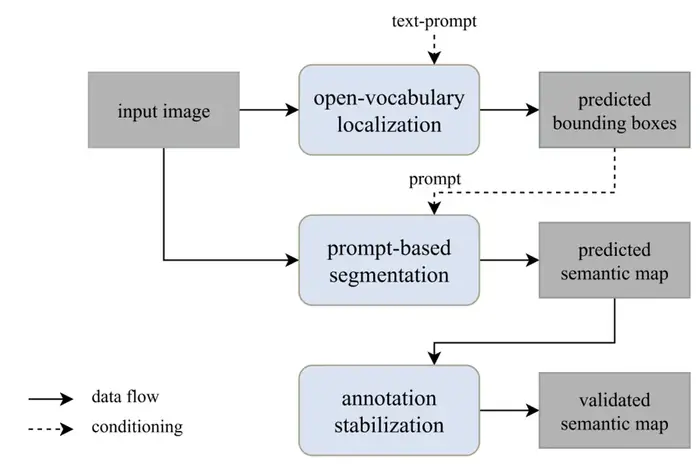
This work investigates whether open-vocabulary grounding and segmentation models can generate pixel-level annotations under strong domain shift in pedestrian-centered scenes. It combines language-guided object localization with prompt-based segmentation and a conservative filtering strategy. The resulting pseudo-labels are used to train and evaluate several architectures for binary sidewalk segmentation and road–sidewalk segmentation. High-capacity models exceed 80% mIoU for binary sidewalk segmentation. The results indicate that foundation-model-based annotation pipelines can provide a practical starting point for datasets in low-resource assistive-vision domains, while semantic grounding under domain shift remains a key limitation.
Keywords
- semantic segmentation
- open-vocabulary annotation
- foundation models
- assistive vision
- pedestrian scene domain shift
Download
Figures
2 visuals from the paper.
-
Fig. 1: Foundation-model-based annotation pipeline with open-vocabulary localization, prompt-based segmentation, and downstream annotation stabilization. -
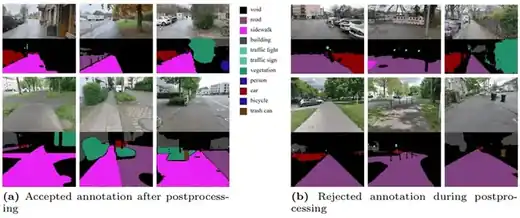
Fig. 2: Comparison of accepted and rejected annotations in the BGH dataset after postprocessing.
Additional notes
Research context
The work grew out of Justine Buss’s bachelor’s thesis and addresses a central prerequisite for assistive computer-vision systems: how domain-specific training data can be created with manageable manual effort.
The contribution was presented at ECCV 2026 in Malmö as a cross-contribution to the workshops ACVR – Assistive Computer Vision and Robotics and CDEL – Curated Data for Efficient Learning. It belongs to Owli-AI’s assistive computer vision and mobility research strand, which also includes the experimental Way-Buddy demonstrator.